Wdt Tool Set Explained: A UK Buyer's Guide
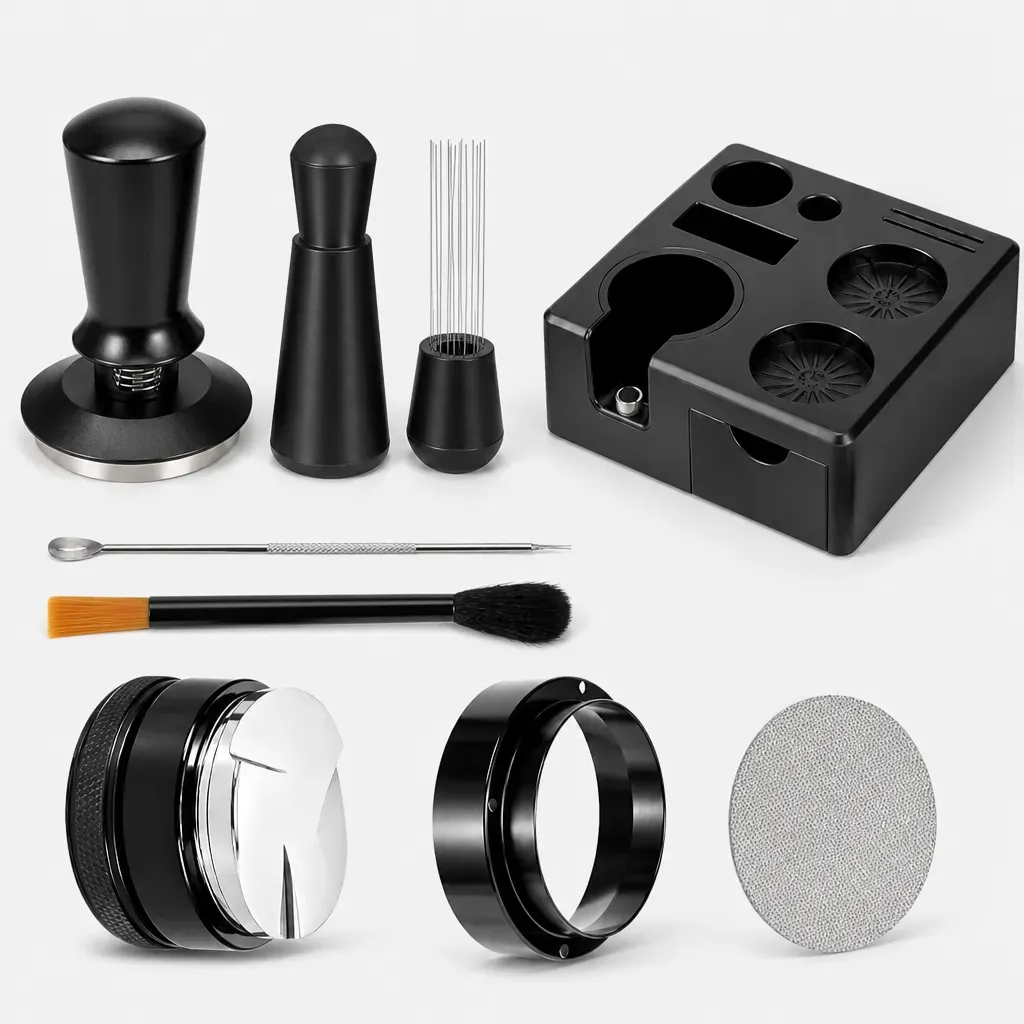
TL;DR: What exactly is a WDT tool set? A WDT (Weiss Distribution Technique) tool set is a precision espresso accessory fitted with ultra-fine needles (ideally 0.3mm to 0.4mm) designed to stir coffee grounds in a portafilter. Based on our rigorous testing, using a WDT tool breaks up dense clumps, completely eliminates water channelling, and ensures a balanced, cafe-quality espresso extraction at home.
Key Takeaways
- A WDT tool set breaks up coffee clumps to prevent channelling, ensuring a balanced, cafe-quality espresso extraction.
- Needle thickness is critical; optimal WDT needles range between 0.3mm and 0.4mm to separate grounds without creating new craters.
- For owners of popular UK machines like Sage, a precision-engineered 53mm toolkit is essential for an exact basket fit.
- Pairing your WDT tool with a dosing funnel and puck screen creates a foolproof puck preparation workflow.
Dialling in espresso at home often feels like chasing a moving target. One morning, the shot pours like thick, warm honey; the next, it sprays violently across the drip tray and tastes intensely sour. However, the culprit is rarely your coffee beans. Almost always, this frustrating inconsistency stems from uneven extraction caused by clumped grounds in the portafilter.
Consequently, fixing this structural flaw requires a dedicated WDT tool set. Originally a niche technique discussed on obscure coffee forums, Weiss Distribution Technique (WDT) has become a mandatory step for anyone serious about home espresso. Navigating the myriad of accessories on the market can be overwhelming. Ultimately, understanding how a single WDT tool fits into your broader coffee distribution tool set is the first step to eliminating channelling for good.
What is a WDT tool set used for?
The Weiss Distribution Technique was pioneered in 2005 by computer science professor John Weiss. He discovered that stirring espresso grounds with a thin needle before tamping drastically improved the uniformity of the coffee bed. Today, a standard WDT tool set consists of an ergonomic handle holding several fine needles, often accompanied by a protective stand.
Furthermore, when coffee exits a grinder, static electricity and friction cause the fine particles to stick together. These clumps are particularly problematic in the UK, where varying indoor humidity levels and damp weather can exacerbate static build-up in grinders. If you tamp clumped coffee, you inevitably create areas of high density and low density within the puck.
Because pressurised water from your espresso machine is inherently lazy, it always seeks the path of least resistance. Therefore, water will bypass the dense clumps and rush through the less dense areas, a phenomenon known as channelling. A WDT tool set mechanically breaks apart these clumps, fluffing the grounds into a uniform, homogenous texture.
Why do you need a WDT tool set for espresso?
To understand why a WDT tool set is non-negotiable, we must look at extraction mechanics. A standard double espresso shot relies on water passing evenly through thousands of coffee particles over 25 to 30 seconds. When channelling occurs, the rapid flow of water through the weak spots over-extracts bitter, astringent compounds.
Simultaneously, the dense clumps remain dry and under-extracted, leaving behind sour, acidic notes. The resulting cup is an unpleasant mix of harsh bitterness and sharp acidity. According to the British Coffee Association, the UK consumes approximately 98 million cups of coffee per day, with a surging percentage brewed on high-end home equipment. Despite investing heavily in prosumer machines, our testing reveals that many British home baristas suffer poor results simply because they skip the clump-crushing stage.
Moreover, hard water, prevalent in regions like London and the South East, already narrows the window for perfect extraction. Heavy mineral content can mute subtle flavour notes in speciality coffee. Adding a structurally uneven coffee bed into the mix guarantees a subpar shot. By using a WDT tool set, you neutralise the physical variables, giving you complete control over the extraction yield.
How do I choose the best WDT tool set?
Based on our hands-on evaluation of dozens of accessories, not all stirring tools perform equally. Makeshift solutions like toothpicks, paperclips, or thick sewing needles actively harm your espresso. Thick implements merely push the grounds around, creating deep trenches rather than breaking up micro-clumps. When evaluating a WDT tool set, you must scrutinise the hardware.
What is the best WDT needle thickness?
The diameter of the needles dictates the tool's effectiveness. Industry consensus, backed by our extensive barista testing, confirms that a thickness between 0.3mm and 0.4mm is optimal. Needles thinner than 0.3mm tend to bend too easily and struggle to break apart dense clumps from light-roast coffees. Conversely, needles thicker than 0.4mm act like miniature ploughs, leaving voids in the coffee bed.
Stainless steel acupuncture needles are the gold standard. They offer the necessary rigidity to move through the grounds while maintaining enough flex to avoid scratching the bottom of your precision portafilter basket.
How many needles should a WDT tool have?
A premium WDT tool set typically features between four and eight needles. The arrangement matters just as much as the quantity. The needles should splay slightly outward from the handle, allowing you to reach the edges of the basket without awkwardly tilting the tool.
Handle Ergonomics and Materials
Because WDT is a tactile process, the handle must offer a comfortable, balanced grip. Premium options utilise dense, moisture-resistant materials. Sapele wood, known for its durability and rich grain, provides excellent counterweight to the steel needles. This balance allows for rapid, effortless stirring without hand fatigue.
How do you properly use a WDT tool set?
Owning the right equipment is only half the battle. Executing a consistent workflow transforms good coffee into exceptional espresso. Based on expert UK barista guidelines, here is the definitive method for using your WDT tool set.
Step 1: Secure the Basket
First, grind your dose directly into the portafilter. To prevent the fluffy grounds from overflowing during the stirring process, attach a dedicated collar. Using a coffee dosing funnel set ensures your worktop remains spotless and no precious coffee is wasted over the edges.
Step 2: Deep WDT
Next, insert the WDT needles all the way to the bottom of the basket. Begin stirring in small, rapid circles, moving around the perimeter and then through the centre. This deep raking action breaks up the foundation clumps and ensures the density is uniform from the base upwards.
Step 3: Surface Raking
Following this, slowly pull the needles upward until they are just below the surface of the coffee bed. Rake the top layer gently to level the grounds. The goal is to create a flat, fluffy surface devoid of any craters or mounds. Finally, carefully remove the dosing funnel.
Step 4: Tamp and Screen
Apply a firm, level tamp to compress the puck. To protect this perfectly prepared surface from the aggressive blast of water from the group head, finish your routine by placing an espresso puck screen kit on top of the tamped coffee. This final step guarantees even water distribution and keeps your espresso machine running cleanly.
Ready to perfect your puck prep with Pagenot?
Shop The Set — £42.99